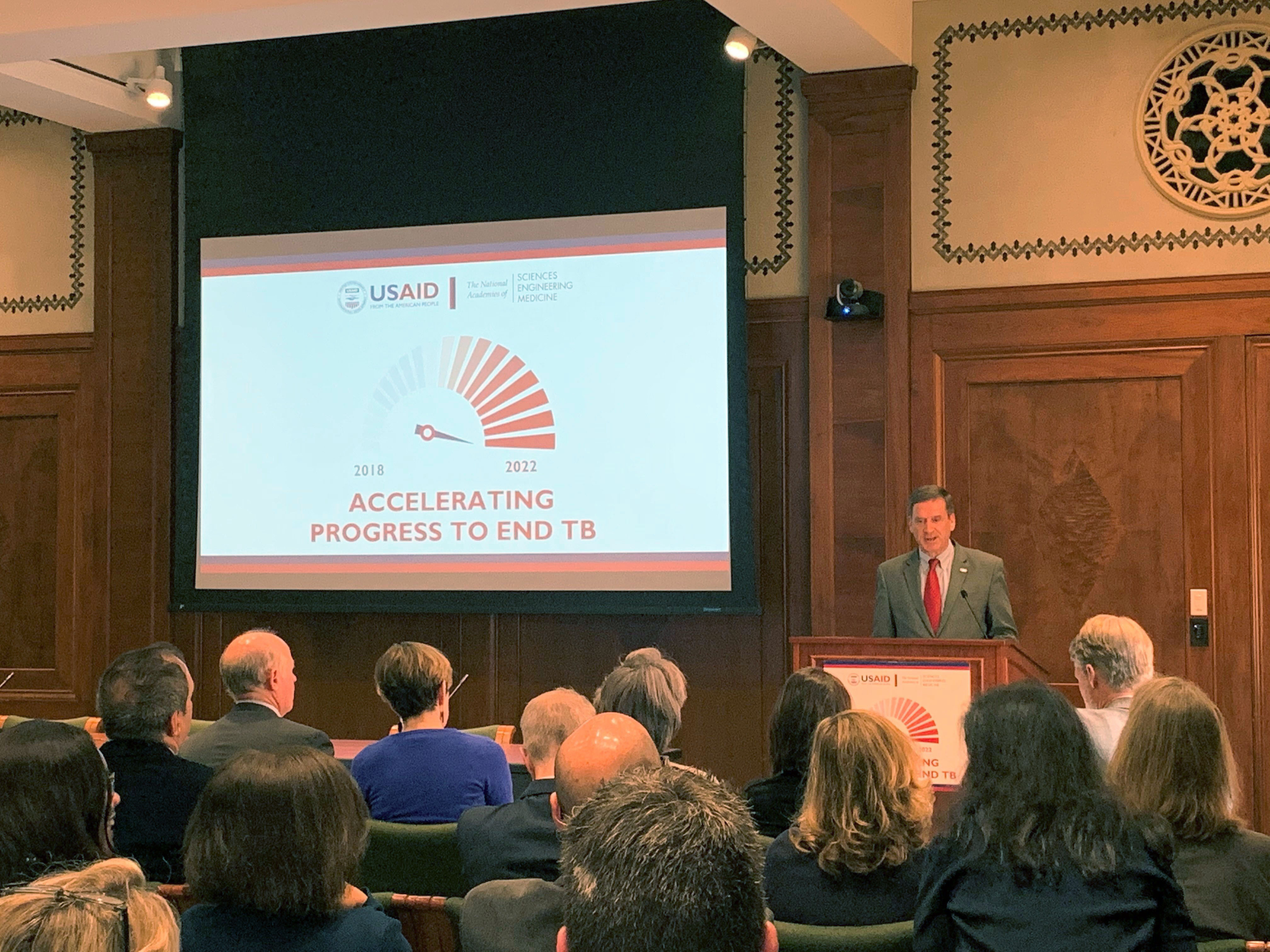
Domestic and global stakeholders gathered at the National Academies of Sciences, Engineering, and Medicine, in Washington, D.C., on November 26, to mark the first year of the Global Accelerator to End Tuberculosis (TB), an initiative of the United States Agency for International Development (USAID).
“TB claims 1.5 million lives each and every year,” USAID Administrator Mark Green told the packed lecture hall. “TB also carries a vicious stigma. It’s an obstacle to prosperity. I’m proud that USAID has been on the frontlines of the fight against TB and working with partners like those who are here today and represented today.”
The Accelerator’s model to fight TB responded to global targets set in September 2018 at the United Nations General Assembly High Level Meeting (UNHLM) on the Fight to End Tuberculosis. These targets are to diagnose and enroll an additional 40 million people in TB treatment by 2022, with a focus on countries with the highest TB burden, and to enroll 30 million people in TB preventive therapy. The Accelerator is designed to increase investments from the public and private sectors to end the TB epidemic, while simultaneously building local commitment and capacity to achieve the goals set forth at the UNHLM. The Tuberculosis Data, Impact Assessment and Communications Hub (TB DIAH) was the first project that USAID awarded under the Accelerator. TB DIAH aims to ensure optimal demand for and analysis of TB data and the appropriate use of that information to inform national TB programs and USAID interventions and policies and measure their performance.
Green said that, since 2014, USAID has reduced the number of TB deaths in high-burden countries by 50 percent, saving 58 million lives. Earlier that day, he said, statements of partnership between USAID and the ministries of health of 17 countries with a high TB burden had been posted to USAID’s website, highlighting country-level commitment and transparency in the fight to end TB.
“At the launch [last year], I committed us to 50 direct awards to local organizations,” Green said. “I am proud to announce eight such awards. Six of them are new USAID partners. As local organizations, these new partners are trusted voices in their communities that we’re all trying to reach.”
A representative of one of those local partners, Milton Omondi, MBChB, MPH, of the Kenyan Conference of Catholic Bishops, spoke during the celebration’s first panel discussion about locally generated solutions to end TB.
“TB is a major public health concern in Kenya,” Omondi said. “The church has a role to play in advocacy. We can get the attention of the political class.”
Joining Omondi on the panel was Safarali Naimov, a TB survivor from Tajikistan. Naimov shared a powerful, personal account of how TB has ravaged his family, killing two of his brothers. He said, “We kept asking ourselves, ‘why is the treatment not working?’ It was because it was multidrug-resistant TB.”
Since recovering from TB, Naimov has made ending TB in Tajikistan his life’s work. He manages projects on TB prevention at the Stop TB Partnership, Tajikistan. He stressed the importance of providing counseling to people diagnosed with TB.
The panel’s third and final commenter was Joanne Carter, DVM, executive director of RESULTS. “I feel like I have so much to learn from these local partners to close the advocacy and implementation gaps,” Carter said. “Please keep asking for the resources you need and empowering TB survivors to become leaders in this movement.”
Another panel discussion focused on building global and country commitment to end TB. Panelists were the executive director of the Stop TB Partnership, Lucica Ditiu, MD; Tajikistan’s ambassador to the United States, Farhod Salim; and Malawi’s ambassador to the United States, Edward Sawerengera. Sawerengera highlighted Malawi’s approach to find missing TB cases, including dispatching mobile diagnostic units. Salim said Tajikistan seeks to improve the infrastructure of health centers over the next three years. Ditiu said that continued political leadership and commitment, country-level work, feelings of hope, access to the latest diagnostic tests, and money are needed to end the epidemic.